
November Birthstone, Citrine and Topaz in Their Honey-Yellow Range
The November birthstone is two stones, citrine and topaz. Both run through honey-yellow into golden-orange, and both have older histories than the modern jewellery calendar suggests.

Quick facts3ShowHide
- ElementFire
- ZodiacScorpio, Sagittarius
- Sits well withConfidence, abundance, late-autumn focus
The November birthstone is two stones, not one. Citrine is the yellow quartz that fills most modern jewellery calendars. Topaz is the older traditional stone, a separate mineral entirely, prized at its best in the orange-pink imperial variety. Both belong to November, and both run through the same honey-yellow range that gives the month its character.
What is the November birthstone?
The November birthstone is citrine in the modern calendar and topaz in the older traditional one. Both are recognised. Most contemporary jewellers default to citrine because it is widely available and sits at a lower entry price, but topaz has not been dropped from the tradition. It sits alongside citrine on most serious birthstone lists, and for some people it is the better fit.
If you came here looking for one tidy answer, the honest one is that November is a two-stone month. The two overlap in colour but differ in mineralogy, hardness, and history. Knowing both lets you choose the stone that suits the person, rather than the one a chain store keeps in the case.
Citrine, the yellow quartz November birthstone
Citrine is the yellow to golden-brown variety of quartz, chemically silicon dioxide, the same family as amethyst, smoky quartz, and rock crystal. The colour comes from trace iron held inside the quartz lattice. Hardness sits at 7 on the Mohs scale, durable enough for daily wear in rings, pendants, and earrings without much fuss. The name comes from the Old French citrin, meaning lemon, and it has stuck for several centuries because it describes the stone exactly at its paler end.
The honest complication is that most citrine on the open market is heat-treated amethyst. Amethyst and citrine are the same mineral with different trace iron states. Heating amethyst to around 470 degrees Celsius shifts the iron and produces a stone that is mineralogically citrine but visually a slightly orange-tinted yellow rather than the cooler lemon of natural citrine. The treatment is stable, standard in the trade, and accepted at most price points. It does not need to be disclosed at entry-level retail, which is why most casual buyers have only ever seen treated material.
Natural citrine is rarer. It runs paler, often a soft champagne yellow rather than the deep amber of treated stone, and commands a premium when sold honestly. Significant natural deposits sit in Brazil (the Rio Grande do Sul region), Madagascar, and parts of Russia. A reputable seller will tell you which you are buying. A vague answer usually means treated.
The fuller mineralogy sits in the citrine complete guide, and the citrine crystal page covers the technical profile.
Topaz, the older November birthstone
Topaz is a separate mineral entirely, a silicate of aluminium and fluorine with the formula Al2SiO4(F,OH)2. Hardness sits at 8 on the Mohs scale, harder than citrine and most quartz, with a clean basal cleavage that cutters work around carefully. The stone runs through a wide colour range: colourless, pale yellow, sherry-brown, blue, pink, and the prized orange-pink of the imperial variety.
The name has a tangled history. The Greek topazos originally referred not to topaz at all but almost certainly to peridot, mined from the small Red Sea island the Greeks called Topazios (now Zabargad). For centuries, any yellow-green stone passing through Mediterranean trade was called topaz, and the name attached itself to peridot, chrysoberyl, and citrine in turn. The mineral now properly called topaz inherited the label by accident sometime in the medieval period, after the older usage had drifted out of memory.
When a Roman writer or a medieval lapidary mentions topaz, the stone described is often peridot or yellow corundum. The shift to the modern usage was not formalised until the eighteenth century, when systematic mineralogy began separating species by composition rather than colour.
Topaz handles daily wear well, with the cleavage caveat. A ring setting needs to protect the stone from sharp knocks along the cleavage plane. Pendants and earrings are gentler positions.
Imperial topaz
The premium variety. Imperial topaz runs from a saturated golden-orange through to a delicate pink-orange, and the very best stones show a slight colour shift between the two under different light. The colour comes from chromium and iron in combination, a different cause from the iron-only colouring of yellow citrine.
Almost all imperial topaz on the market comes from a small set of mines around Ouro Preto in the Minas Gerais region of Brazil. The deposit has been worked since the eighteenth century and remains the only commercial source of fine material. Production is small. A two-carat stone of clean colour is a serious piece. A five-carat clean stone is collectible.
The name traces to the nineteenth century. Russian imperial families patronised pink topaz from the Urals, and Brazilian producers later borrowed the imperial association for the Ouro Preto material. Pink topaz from the Urals is now nearly mined out, so most stones sold as imperial today are Brazilian. Price sits well above blue or colourless topaz, and well above any citrine.
November birthstone history
The two-stone tradition for November is older than the modern calendar.
Citrine has the older popular reputation as the merchant's stone. The association traces to medieval and early-modern European trading culture, where merchants kept small citrine pieces in cash boxes and ledgers. A yellow stone the colour of gold, kept close to where money moved, was meant to draw more of the same. The folk practice persisted into the nineteenth century and is still cited in modern crystal writing.
Topaz carried different associations. Greek and Roman writers, working with what was probably peridot under the topaz name, recorded the stone as a guard against night fears and a clarifier of vision. By the medieval period, topaz appeared in lapidary texts as a stone for steady judgement. Some of this carried into Renaissance jewellery, where yellow topaz was set into reading pendants.
The modern birthstone list that places citrine in November was standardised in 1912 by the American National Association of Jewelers (now Jewelers of America). The body wanted a tidy commercial calendar with one stone per month. Citrine was widely available, photographed well, and sat at an affordable entry price. Topaz was kept on most lists as the secondary or traditional November stone, and it remains there.
November birthstone meaning and tradition
November in the northern hemisphere is late autumn, the month when light pulls back and the year tilts toward winter. In the southern hemisphere it is late spring moving into summer. Either direction, November is a focusing month, the part of the year where attention narrows.
Both birthstones map onto that focus from different angles.
Citrine carries the warmth and abundance thread. The yellow-gold colour and the merchant's stone tradition share a single shape: a held warmth against the fading outside light, a steadiness around what has been built and what is still to come. People reach for citrine in late autumn the way they reach for honey and warm spices, for the same reason.
Topaz carries the clarity thread. Where citrine warms, topaz sharpens. The older tradition reads topaz as a stone for clear judgement and steady looking. In late-autumn pacing, when decisions about the year ahead start to settle, topaz fits the slower mental work the season asks for.
Modern crystal practice associates both stones with the solar plexus chakra, the centre of confidence and personal power. Citrine sits there in the warm yellow tone. Topaz, in its yellow and imperial varieties, sits there with a slightly cooler edge. Wearing both, or alternating, fits the older logic of the month.
How to choose a citrine or topaz
A few honest notes for buyers.
For citrine. Look at the stone in daylight, not under jewellery-case spots. Natural citrine reads soft champagne. Heat-treated amethyst reads warmer, with a slight orange tint. Both are fine to buy, and the price should reflect which you are getting. Avoid pieces showing a colour-zoned smoky-purple base, which usually means incompletely converted amethyst.
For blue topaz. The widely available blue topaz in jewellery cases is irradiated and heat-treated to produce the colour. Untreated blue topaz exists but is very pale. The treatment is stable and accepted. A clean Swiss blue or London blue topaz at modest prices is standard market material, not a bargain or a red flag.
For imperial topaz. Treat any imperial-topaz purchase the way you would a fine sapphire purchase. Buy from a dealer who can name the mine and provide a clean stone. Ask about heat treatment, which is occasionally applied to lift the colour. Untreated Ouro Preto stones with strong saturation are collectible and priced accordingly.
Care. Both stones handle water well at moderate temperatures. Topaz cleavage means avoiding ultrasonic and steam cleaning. Mild soap and warm water is enough for both. Keep topaz in a soft pouch separate from harder stones to avoid cleavage knocks.
November birthstone gift ideas
A short guide by intention rather than budget alone.
For someone warm and steady by nature. A citrine pendant or stud earrings in yellow gold or warm brass. The stone reads soft and sun-coloured against most skin tones and wears for decades.
For someone who already has citrine. A small imperial topaz piece, deliberately. Most people raised on the modern birthstone chart have never been offered the second stone. A well-cut imperial topaz, given with a sentence about the older tradition, lands well.
For a luxury gift. Yellow sapphire sits outside the official birthstone list but matches the November palette and outranks both stones in hardness and brilliance. A yellow sapphire ring is the upper end of November-themed gifting.
For a starter or affordable gift. Honey calcite is the gentle, lower-cost alternative. The colour matches the November range, the stone takes a simple polish, and pieces at modest prices are easy to find. It is not a birthstone in the formal sense, but as a small considered gift in November tones it works.
For the broader ritual context, the November birthstone page collects the stones, dates, and traditions in one place.
November birthstone and zodiac
November straddles two zodiac signs, and both pair sensibly with the two birthstones.
Scorpio (October 23 to November 21). Water sign, ruled by Pluto and Mars, traditionally associated with depth, focus, and the slow work of transformation. Citrine pairs well as the warming counterweight to the Scorpio tendency toward intensity. The solar-plexus warmth keeps the depth from tipping into heaviness. Topaz sits as the secondary pairing, particularly imperial topaz, where the saturated colour matches Scorpio's preference for stones with weight and presence.
Sagittarius (November 22 to December 21). Fire sign, ruled by Jupiter, traditionally associated with expansion, optimism, and movement. Citrine is the natural primary pairing here. The sunny yellow and the abundance tradition align cleanly with Sagittarian forward motion. Blue topaz works as a secondary, particularly for the Sagittarian who travels and wants a stone with the older clear-vision association.
For people born in the Scorpio-Sagittarius cusp, the last days of November and first of December, the two-stone tradition is unusually appropriate. The month was always meant to carry both the warm grounding stone and the clarifying one.
The right November birthstone is the one that fits the person, not the one a retail chart picked in 1912. Knowing both, and what each carries, is most of the work.
Want a piece from this guide?
Until our shop is live, we hand-arrange orders through Instagram. Tap to ask what is currently available.
Preview the message
Hi AU Crystals,

I was reading your November Birthstone, Citrine and Topaz in Their Honey-Yellow Range page (aucrystals.com/blog/november-birthstone-guide).

I wanted to ask about the stones in this guide.
A starter message gets copied to your clipboard. Paste it into the DM on Instagram.
A few honest questions.
What is the November birthstone?
November has two birthstones. Citrine is the modern stone listed in most jewellery calendars, a yellow to golden-brown variety of quartz. Topaz is the older traditional November stone, a silicate that runs from colourless through yellow into the prized orange-pink imperial variety.
Is most citrine on the market natural?
No. Most commercial citrine is heat-treated amethyst, which produces a slightly orange-tinted yellow that is stable and accepted in the trade. Natural citrine is rarer, paler, and commands a premium. Both are real citrine by mineralogy. Knowing which you are buying is the honest part.
What is imperial topaz?
Imperial topaz is the orange to pink-orange variety of topaz, historically mined from the Ouro Preto region of Brazil. It is the most prized topaz colour and sits well above blue or colourless topaz in price. The name traces to Russian and Brazilian imperial associations in the nineteenth century.
What is a good November birthstone gift?
For most people, a citrine pendant or stud earrings sit well in daily wear, particularly in warm metal settings that suit the yellow tone. For someone who already has citrine, a small imperial topaz piece or a faceted blue topaz makes a thoughtful second gift. Honey calcite is the affordable, gentler alternative for early gifts.
Keep reading.
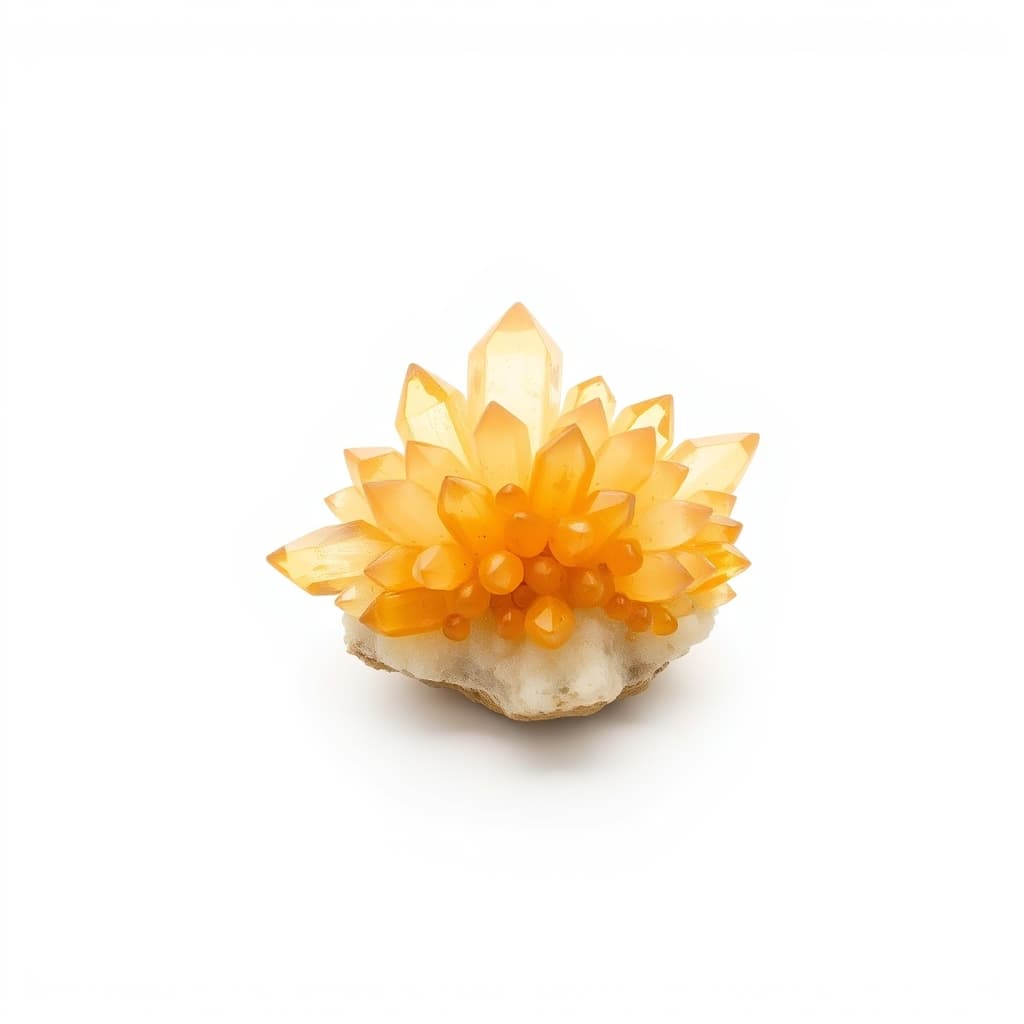
Citrine, and the Quiet Trouble With Most of What You Buy
Real citrine is one of the rarer quartz varieties. Most of what sells under the name is heat treated amethyst. Here is how to tell the difference, why it matters, and what the stone traditionally stood for before any of that got complicated.
Crystals for Love and Relationships, Traditional Companions
The stones paired with love across Hellenistic, Vedic, and European folk sources, and what each one actually supports. Written for self-compassion and relational work, not romantic manifestation.
Crystals for Abundance, a Considered Practice
The traditional abundance stones, what the word actually meant in older practice before contemporary wealth marketing attached to it, and how to work with them slowly. Written for people who want a real practice.
Sit with us on Sundays.
One quiet letter every week. New writing, a crystal to consider, and whatever we have been thinking about. No tracking pixels, no affiliate noise.
By subscribing you agree to receive weekly emails from AU Crystals. Unsubscribe anytime. See our privacy note.