
A Full Moon Ritual That Actually Works, Considered and Slow
The traditional full moon practice written without manifestation marketing. What the lunar cycle symbolises, which crystals belong in the ritual, and a simple three-step version you can do on any full moon of the year.
Quick facts11ShowHide
- ChakraCrown (Sahasrara), Third Eye (Ajna)
- Mohs hardnessn/a
- Mineral familyLunar practice
- OriginVedic, Hellenistic, European folk, Indigenous
- ColourSilver, white
- ElementWater
- ZodiacCancer (ruler), all signs practice
- Sits well withReflection, release, reset
- Water safen/a
- Sun safen/a
- RarityUniversal practice
The full moon ritual is one of the oldest continuously observed practices in the world. Almost every culture with access to the night sky built a version of it, long before the current wave of manifestation content recast it as a goal-setting exercise. This guide returns to what the tradition actually was. A quiet reflection practice, once a month, marking a pause in the cycle. You can do it with three crystals and fifteen minutes.
Why the full moon matters
The full moon is the most visible point in the lunar cycle. It is high in the sky, fully illuminated, impossible to miss. For cultures living without electric light, the full moon was the one night of the month when outdoor activity at night was practical. Traditions accumulated around it because it was the obvious time to gather.
Beyond the practical, the full moon became the symbolic marker of completion. The new moon, invisible, represents beginning. The waxing half represents growth. The full moon represents the peak, the moment before decline. In traditional practice, the full moon is a time of release rather than setting. You acknowledge what has grown during the cycle, and you let go of what does not need to continue.
This is the piece that most contemporary full moon content gets wrong. The full moon is not primarily a manifestation moment. It is a releasing moment. The new moon is where intentions are traditionally set.
The traditional crystals
Three stones anchor the full moon ritual across the traditions that mention specific crystals.
Moonstone
The direct lunar stone. Moonstone has been used in full moon ritual across Roman, Indian, and Arab traditions, valued for its visible internal shimmer that was traditionally said to mirror the moon's own light. A small polished piece is the classic inclusion.
Selenite
Selenite, named after the Greek goddess Selene, is the second stone traditionally associated with lunar practice. Its soft luminous white colour and association with the crown chakra fit the reflective quality of full moon work. Many practitioners keep a selenite wand specifically for this use.
Clear quartz
Clear quartz is included because of its amplification tradition. The full moon ritual has a specific intention, and clear quartz holds that intention alongside the moonstone and selenite without adding a competing symbolic layer.
These three are the classical set. You do not need all three. One is enough if it is what you have. The ritual is about the practice, not the equipment.
A simple three-step ritual
What follows is a compact version of the practice, distilled from common elements across traditions. It takes fifteen to twenty minutes.
Step 1. Set up
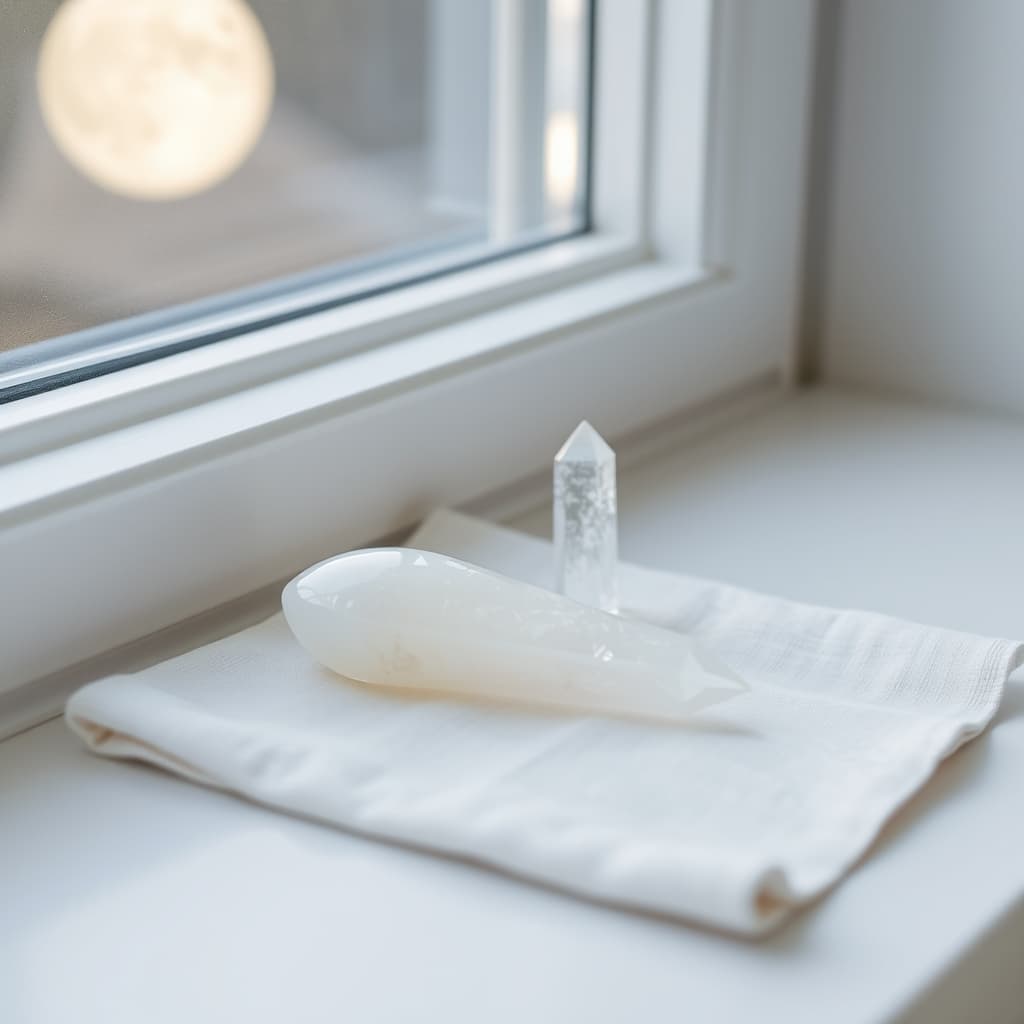
On the evening of the full moon, find a window where moonlight reaches, or a safe outdoor space. Place your crystals somewhere the moon can see them, a windowsill or a small cloth on a balcony.
Bring one sheet of paper and a pen. Sit down.
Take three slow breaths. Let the breath settle any rushing thought.
Step 2. Reflect and release
Write, in two or three sentences, what has happened in you during the past lunar cycle. Not a to-do review, not a performance summary. What has weighed on you. What has asked for attention. What has started or finished without you deciding.
Then write, in one sentence: What am I ready to let go of before the next cycle begins?
Do not force an answer. If nothing clear arrives, sit with the question. Often the answer surfaces in the quiet.
When something does come, write it down. Something small is fine. The tradition does not require dramatic releases. A resentment, a worry, a habit of overworking. Small things release more reliably than large ones.
Step 3. Close
Read what you have written aloud, softly, once. Then fold the paper in half. Some traditions burn it in a small safe fire or bury it in the garden. Others simply put it in a drawer and let it age. Either way, the act of naming and setting aside is the ritual.
Leave the crystals in moonlight for the night. This is also traditional full moon cleansing (see our crystal cleansing guide for more on this).
In the morning, retrieve the crystals. The paper can stay where you left it.
Timing and frequency
The three-night window. The ritual can be done on the night of the full moon itself or either of the two nights on either side. The moon appears visibly full for the full three days, and the tradition accommodates this. Weather, travel, or a demanding week are all reasons to use the adjacent nights.
Monthly rhythm. The practice repeats every 29.5 days (a lunar cycle). Twelve or thirteen times per year. Most practitioners do not hit every single full moon, and that is fine. Seasonal observance (one per season, four per year) is also traditional.
Special full moons. Some full moons have additional significance. The harvest moon (closest to the autumn equinox), the blue moon (second full moon in a calendar month), and the supermoon (when the moon is closest to Earth in its orbit) all have layered meaning. None is required for the practice to work. The ordinary monthly full moon is enough.
Pairing the ritual with intention setting
If you want a fuller monthly rhythm, pair the full moon ritual with a new moon intention-setting practice two weeks later. The full moon releases. The new moon sets. Between them is the settling, the small period of rest before the next cycle begins.
This is the classical Vedic and Hellenistic pairing, and it makes the lunar practice feel like a rhythm rather than a single event.
What to avoid
Three common mistakes that dilute the practice.
Making the ritual performative. Social media has pushed full moon ritual toward photographable aesthetics. Elaborate altars, coordinated candles, perfect crystal arrangements. None of this is traditional. The practice was always quiet and often solitary.
Manifesting at the full moon. As noted above, the full moon is traditionally for release, not setting. If you want to set a specific intention, wait for the new moon two weeks later. Using the full moon for manifestation is a modern repurposing that loses some of the original meaning.
Skipping the reflection. The whole point is the fifteen minutes of quiet. If you hurry the sitting and focus on the crystal arrangement instead, you have done the decoration without the practice. Sit first, crystals second.
A closing thought
The full moon will happen whether you ritualise it or not. The value of the practice is that it creates a regular appointment with your own interior, once a month, with a clear physical marker outside the window. Over a year, twelve such appointments add up to a considerable amount of quiet attention. That is the tradition.
For more on the stones that belong in this practice, see our moonstone guide and selenite guide. For broader context on how crystals fit into monthly rhythm, see our zodiac master guide.
Want a piece from this guide?
Until our shop is live, we hand-arrange orders through Instagram. Tap to ask what is currently available.
Preview the message
Hi AU Crystals,

I was reading your A Full Moon Ritual That Actually Works, Considered and Slow page (aucrystals.com/blog/full-moon-ritual-complete-guide).

I wanted to ask about the stones in this guide.
A starter message gets copied to your clipboard. Paste it into the DM on Instagram.
A few honest questions.
Does the full moon ritual require specific timing?
The ritual works on the night of the full moon or the two nights on either side (total three nights). Many practitioners prefer the night when the moon is fullest, but the three-night window is traditional and accommodates weather or schedule.
Do I need crystals to do a full moon ritual?
No, but crystals traditionally accompany the practice because the ritual involves sitting with intention, and a physical focal point helps. Moonstone, selenite, and clear quartz are the three most traditional.
Is this practice tied to a specific religion?
Full moon observance appears across almost every culture with lunar tradition, from Vedic and Buddhist uposatha days to European folk practice to Indigenous seasonal markers. The version in this guide draws from the common elements across traditions rather than any single one.
Should I set intentions or let them come?
Both work. Some practitioners write a specific intention in advance. Others sit quietly and let whatever has been weighing on them surface. The full moon tradition historically favoured release over setting new intentions (the new moon is the setting time in most traditions).
Keep reading.
Moonstone, and the Soft Kind of Strength
A stone that glows from the inside in the right light. Where adularescence comes from, why rainbow and blue moonstone are different creatures, and the long tradition of carrying one during change.
Selenite, the Delicate One
Soft enough to scratch with a fingernail, translucent enough to look lit from within. A careful guide to a stone that asks for more care than most, and why the traditional charging practice makes more sense than it might first appear.
How to Cleanse Crystals, Seven Methods Honestly Compared
The cleansing methods that survived across traditions, which stones tolerate each one, and how to pick the right method for your stone rather than following generic advice that damages softer crystals.
Mentioned in
Sit with us on Sundays.
One quiet letter every week. New writing, a crystal to consider, and whatever we have been thinking about. No tracking pixels, no affiliate noise.
By subscribing you agree to receive weekly emails from AU Crystals. Unsubscribe anytime. See our privacy note.