
August Birthstone, Peridot the Olive-Green Gem of Late Summer
The August birthstone is peridot, a gem-quality olivine that holds its glow into the evening. A careful look at the stone, its sources, and why some peridot fell from the sky.

Quick facts3ShowHide
- ElementFire, Earth
- ZodiacLeo, Virgo
- Sits well withAbundance, late-summer warmth, steady vitality
The August birthstone is peridot, the gem-quality form of olivine, a stone that holds an apple-green glow longer into the evening than almost any other coloured gem. Older lists also carry sardonyx, and a modern revision added spinel in 2016.
What is the August birthstone?
The August birthstone is peridot in the modern calendar. Sardonyx is the older traditional stone and still appears on most serious birthstone lists. Spinel was added by the American Gem Trade Association and Jewelers of America in 2016 as a third recognised option.
Peridot is the default for most contemporary jewellers because the colour is unusual and instantly recognisable, the supply is steady, and the stone takes a clean cut. Sardonyx is the right answer for anyone drawn to the older Roman and Greek practice. Spinel suits buyers who want a harder, rarer stone in colours from soft pink to deep red.
If you came here for a tidy single answer, peridot is it. The fuller answer is that August carries more than one stone.
Peridot, the gem-quality olivine
Peridot is the gem-quality variety of olivine, a magnesium-iron silicate with the formula (Mg,Fe)2SiO4. Olivine is one of the most common minerals in the Earth's mantle. Most of it sits too deep to reach, but volcanic activity and tectonic uplift bring small pockets to the surface, and a fraction of those pockets produces crystals clear enough to cut.
Hardness sits at 6.5 to 7 on the Mohs scale, softer than aquamarine or sapphire but durable enough for pendants, earrings, and protected ring settings. It is not the stone for a daily-wear solitaire that takes knocks against benches and door frames. In a bezel or a pendant, it lasts decades.
Peridot ranges from pale yellow-green through rich apple-green to deeper olive. Unlike most coloured gems, peridot has almost no pleochroism, meaning the colour reads the same from every angle. The stone also has a notably high refractive index for a green gem, giving cut pieces a soft inner fire.
For the full mineral profile, the peridot crystal page covers structure, common inclusions, and care.
Why peridot glows green
The green in peridot comes from iron, not from chromium or vanadium as it does in emerald and tsavorite. Because iron is part of the olivine formula rather than a trace impurity, the colour is intrinsic to the mineral. The stone is green because it is made of iron silicate.
Romans called peridot the "evening emerald" because the colour holds under candlelight where most green stones turn grey or muddy. Emerald loses much of its green in low light. Peridot keeps its glow because the iron-driven absorption sits in a band that warm artificial light does not flatten. A peridot at a dinner table at dusk reads almost the same colour it does at noon.
The same property makes peridot a good choice for anyone who wants a coloured stone that does not depend on bright daylight to look like itself. Stones cut from the Pakistani Suppat deposit are particularly known for this evening retention.
Peridot sources
A short geographic tour of the stones currently on the market.
Pakistan, Suppat (Kohistan). Discovered in the 1990s, the Suppat deposit in the Himalayas now produces some of the finest peridot in the world. Stones from this source tend toward clean apple-green with high transparency, and large clean pieces over five carats appear regularly. Mining is seasonal because the site sits at high altitude.
Myanmar (Burma), Pyaung-Gaung. Burmese peridot has been worked for centuries and produces large stones in a slightly deeper, more saturated green than Pakistani material.
Arizona, San Carlos Apache Reservation. The San Carlos deposit is the source of most commercial peridot sold in North America. Stones are smaller and slightly more yellow-green than the Asian sources, but the consistency and price make San Carlos peridot the everyday workhorse of the trade. The mining is run by Apache families on tribal land.
Egypt, Zabargad Island (St. John's Island). The oldest known peridot source in the world. Egyptian miners worked Zabargad in the Red Sea for at least three thousand years, supplying the Pharaohs and later the Roman Empire. The deposit is largely worked out today, and any stone genuinely from Zabargad is collectible.
Smaller commercial production comes from China, Vietnam, and Norway. For a collector, Suppat and historical Zabargad pieces command the top of the market. For everyday wear, San Carlos material is honest and affordable.
The meteorite story
Peridot is one of very few gems with a confirmed extraterrestrial origin. Pallasite meteorites, a rare class of stony-iron meteorites, contain gem-grade olivine crystals embedded in a nickel-iron metal matrix. When a pallasite is sliced and polished, the olivine shows as translucent green windows in a silver mirror, and a small fraction of those crystals are clean enough to cut.
Pallasites are thought to form at the core-mantle boundary of differentiated asteroids, where the silicate mantle meets the iron core. When such an asteroid is shattered by collision, fragments fall to Earth, and the olivine inside them is older than the planet we are standing on.
The cut quantities are tiny. Most pallasite olivine produces stones under one carat, and global supply in any year is measured in dozens of pieces. A cut pallasite peridot is one of the few stones you can wear that did not start its life on Earth, and the price reflects the rarity. For most buyers this is a story rather than a purchase, but it is a true one.
August birthstone meaning and tradition
August in the northern hemisphere is the long warm month, the late-summer plateau before autumn begins to register. In the southern hemisphere it sits in the depth of winter. The traditional August stone meanings follow the northern reading because that is where the lists were written.
Peridot carries an abundance and warmth association in nearly every tradition that touches it. Egyptian practice linked it to the sun and to the Pharaoh's authority. Roman use connected it to evening light and prosperity. Medieval European writers associated it with friendship, and with protection against night terrors when set in gold. The common thread is the late-summer abundance reading: a stone for the season of full harvest, long evenings, and sustained warmth.
Modern crystal practice associates peridot with the heart chakra and the solar plexus chakra together, an unusual pairing that fits the stone's behaviour. The heart association comes from the green colour and the friendship tradition. The solar plexus association comes from the warmth, the abundance reading, and the personal-power thread that runs through the Egyptian and Roman uses.
Sardonyx, the older traditional August stone, is a banded chalcedony with red and white layers. Roman soldiers carried sardonyx amulets carved with Mars or Hercules for courage in battle, and the stone was a staple of Greek and Roman signet rings because the layered structure allowed cameos with sharp colour contrast. The August association predates peridot's modern listing by centuries.
For the broader ritual context, the August birthstones page collects all three stones, the dates, and the traditions in one place.
How to choose a peridot
A few honest notes for buyers.
Colour is the first quality marker. The most prized peridot is a clean apple-green with no brown or grey undertone. Yellow-green is acceptable and common, but the stone should not read olive-muddy in daylight. View any peridot in natural light before buying. The "evening emerald" effect is real, but a stone that only looks good in candlelight is a stone with a colour problem.
Clarity should be eye-clean. Peridot is a Type II coloured stone in the trade, meaning small inclusions are normal and acceptable. But the stone is transparent enough that visible inclusions distract more than they do in emerald or ruby. Aim for eye-clean at arm's length. The most common inclusions are "lily pad" disc-shaped features and small mineral crystals, and a faint lily pad is not a fault if the cut places it sensibly.
Cut matters more than people expect. Peridot has high birefringence, meaning a poorly cut stone shows visible doubling of the back facets when viewed face-up. A well-cut peridot is crisp. Very deep cuts tend to muddy the colour.
Carat weight. Peridot is one of the few gems where larger stones stay affordable. Clean five-carat pieces sit well below the price of a comparable emerald, which is why peridot has historically been favoured for statement pendants.
Treatments. Peridot is rarely treated. Almost all peridot on the market is natural in colour, which is unusual among coloured gems and one of the genuine virtues of the stone.
Care. Peridot is sensitive to thermal shock and acid. Avoid ultrasonic cleaning, steam, and household cleaners. Mild soap and warm water is enough. Store separately from harder stones.
August birthstone gift ideas
A short guide by intention rather than budget alone.
For someone born in August who already has peridot. A sardonyx cabochon or signet ring, deliberately. Most people raised on the modern birthstone chart have never been offered the second stone. A piece in red and white banding, given with a sentence about the older Roman use, lands well.
For a collector or someone who likes uncommon stones. A red or pink spinel. Spinel was added to the August list in 2016 and remains under-represented at retail. Burmese pink spinel and Mahenge red spinel from Tanzania are both excellent. Spinel sits at 8 on the Mohs scale, harder than peridot, which makes it the better choice for daily-wear rings.
For someone going through an abundant or expansive season. Peridot, in keeping with the traditional reading. A pendant or earrings that sit visibly in the colour, rather than a small accent piece, fits the abundance association best.
For a child born in August. Peridot, almost always. The colour reads cheerful, the price allows a reasonable size, and the stone is durable enough for a simple pendant. Sardonyx and spinel are stones for adults; peridot fits a fresh life.
August birthstone and zodiac
August straddles two zodiac signs, and both pair sensibly with peridot.
Leo (July 23 to August 22). Fire sign, ruled by the Sun, traditionally associated with warmth, generosity, and visible presence. Peridot pairs naturally. The solar plexus association, the abundance reading, and the historic Egyptian sun-link all sit well with Leo. Sardonyx is the secondary pairing, the older Roman stone of confidence and courage.
Virgo (August 23 to September 22). Earth sign, ruled by Mercury, traditionally associated with discernment, care, and quiet competence. Peridot still pairs well, particularly the cleaner Pakistani Suppat material with its restrained apple-green rather than a louder olive. Spinel is a strong secondary pairing for Virgo, especially the softer pink shades, which suit the more reserved end of the Virgoan range.
For people born on the Leo-Virgo cusp around August 22 to 24, the stone choice is genuinely flexible. A clean apple-green peridot fits both signs without compromise, which is part of why peridot has remained the August default through several waves of birthstone list revision.
The right August birthstone is the one that suits the person, not the one a chain store has in the case. Peridot is the safe and traditional answer, sardonyx is the older and quieter one, and spinel is the modern third option. Knowing all three, and what each carries, is most of the work.
Want a piece from this guide?
Until our shop is live, we hand-arrange orders through Instagram. Tap to ask what is currently available.
Preview the message
Hi AU Crystals,

I was reading your August Birthstone, Peridot the Olive-Green Gem of Late Summer page (aucrystals.com/blog/august-birthstone-guide).

I wanted to ask about the stones in this guide.
A starter message gets copied to your clipboard. Paste it into the DM on Instagram.
A few honest questions.
What is the August birthstone?
The August birthstone is peridot, the gem-quality form of the mineral olivine. Peridot is a yellow-green to apple-green stone associated with abundance, warmth, and the late-summer turn. Sardonyx is the older traditional August stone and still appears on most birthstone lists. Spinel was added in 2016 as a modern third option.
Why is peridot the August birthstone?
Peridot has been associated with August since at least the 1912 American National Association of Jewelers list, and the older Egyptian tradition mined peridot on Zabargad Island for over three thousand years. The stone holds its colour into low light, which fits the long evenings of late summer in the northern hemisphere.
Is peridot really from meteorites?
Some peridot is. Pallasite meteorites contain gem-grade olivine crystals embedded in a metal matrix, and small quantities of cut extraterrestrial peridot reach the collector market each year. The vast majority of peridot sold at retail is terrestrial, mined from volcanic and mantle-derived rock in Pakistan, Myanmar, Arizona, and elsewhere.
What is a good August birthstone gift?
A peridot pendant or stud earrings sit well in everyday wear. For someone drawn to the older tradition, a sardonyx cabochon or signet carries the Roman lineage. For someone wanting a harder, rarer stone, a red or pink spinel works as the modern third option. All three belong to August on serious lists.
Keep reading.

July Birthstone, Ruby and the Quiet Authority of Red Stones
The July birthstone is ruby, the red corundum that has held its place in royal courts and modern jewellery cases for two thousand years. A careful guide to the stone and its alternatives.

September Birthstone, Sapphire the Velvet Blue of Wisdom
The September birthstone is sapphire, the deep blue corundum carried through medieval cloisters and royal regalia. A grounded guide to its colours, sources, meaning, and how to choose a piece worth keeping.
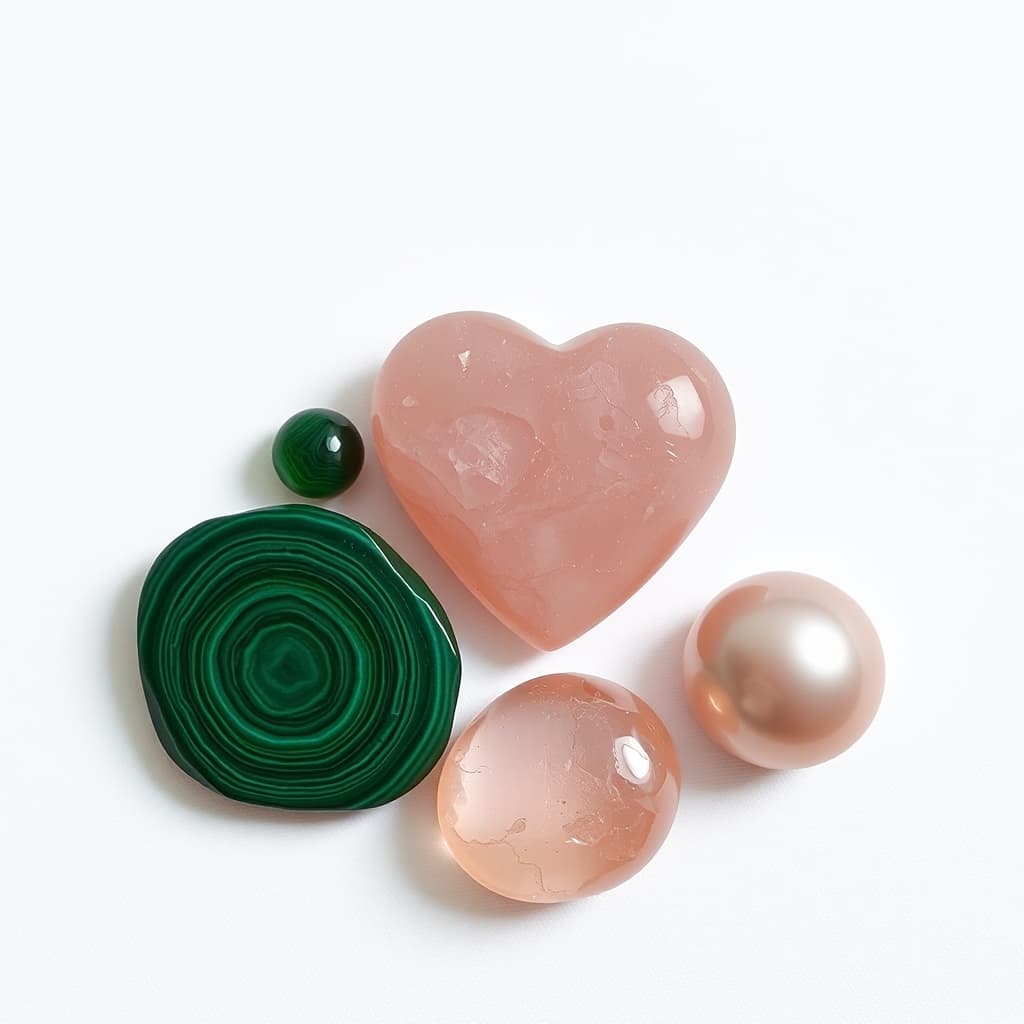
Crystals for Love and Relationships, Traditional Companions
The stones paired with love across Hellenistic, Vedic, and European folk sources, and what each one actually supports. Written for self-compassion and relational work, not romantic manifestation.
Sit with us on Sundays.
One quiet letter every week. New writing, a crystal to consider, and whatever we have been thinking about. No tracking pixels, no affiliate noise.
By subscribing you agree to receive weekly emails from AU Crystals. Unsubscribe anytime. See our privacy note.