
Opal, the Stone of Living Light
A hydrated silica that produces colours no other crystal can match through pure structural diffraction. The mineralogy behind play-of-colour, the major varieties from Australian to Ethiopian to Mexican fire, and how to choose carefully.
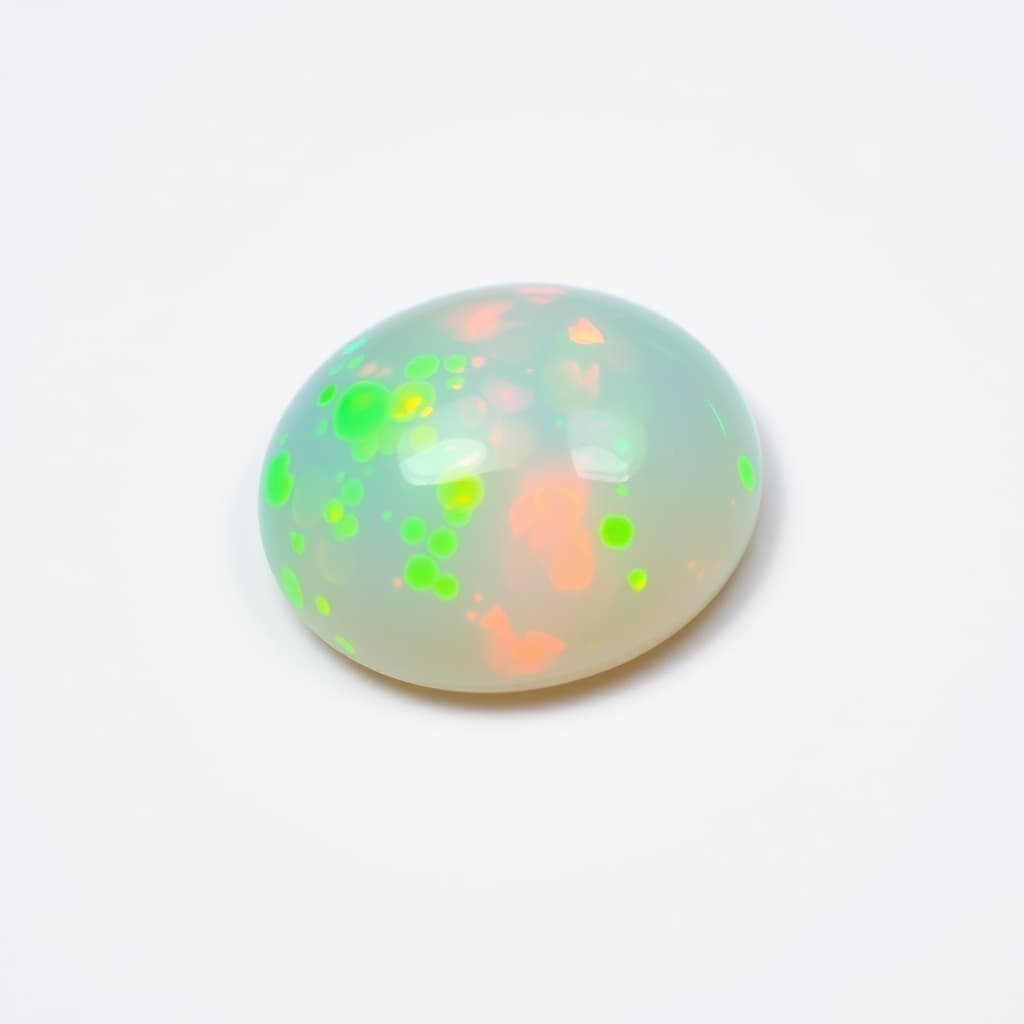
Quick facts11ShowHide
- ChakraCrown (Sahasrara), Third Eye (Ajna)
- Mohs hardness5.5 to 6.5
- Mineral familyHydrated silica (mineraloid)
- OriginAustralia, Ethiopia, Mexico, Brazil, Peru
- ColourWhite, black, fire-orange, blue, with rainbow play-of-colour
- ElementWater
- ZodiacLibra, Cancer
- Sits well withVision work, creativity, intuition
- Water safeYes briefly (stable in water, but humidity changes can crack)
- Sun safeMostly avoid prolonged sun (drying causes crazing)
- RarityCommon opal common, precious opal uncommon, black opal rare
Opal is the only crystal in this catalogue that produces colours no other stone can match, through pure physics rather than pigmentation. The rainbow play-of-colour you see in a fine opal does not come from any colouring mineral; it comes from light bouncing off perfectly arranged microscopic silica spheres, behaving like the surface of a soap bubble or the inside of a CD. This optical magic, combined with opal's water content and fragility, has carried opal through three thousand years of fascination, fear, and reverence. This guide walks through the science, the major varieties, the unfair Walter Scott reputation, and how to buy a real piece in a market full of imitations and triplets.
What it actually is
Opal is hydrated silicon dioxide, formula SiO2 nH2O. It is technically a mineraloid rather than a true mineral because its silica is amorphous (lacking crystal structure) rather than crystalline.
The silica forms as microscopic spheres, typically 150 to 300 nanometres in diameter. In precious opal, these spheres are arranged in a regular three-dimensional lattice. Light passing through the lattice diffracts and produces the rainbow flashes that we call play-of-colour. In common opal, the spheres are arranged irregularly, so no diffraction occurs and the stone shows solid colour without flash.
Opal contains 5 to 20 percent water trapped within its silica structure. This water content makes opal sensitive to humidity changes; if it dries out, the stone can crack (a phenomenon called crazing). This is the source of opal's reputation for fragility.
The varieties
Five major types dominate the market.
| Variety | Body colour | Play of colour | Origin | Notes |
|---|---|---|---|---|
| Black opal | Dark grey to black | Vivid, often red-dominant | Lightning Ridge, Australia | Most expensive |
| White opal | White to pale grey | Pastel rainbow | Coober Pedy, Australia | Most common precious |
| Boulder opal | Opal in ironstone matrix | Vivid against dark backing | Queensland, Australia | Naturally backed |
| Fire opal | Bright orange to red | Often no play (transparent) | Mexico, Brazil | Faceted as gem |
| Welo opal | White to honey | Dramatic rainbow | Wollo Province, Ethiopia | Newer source, very humidity-sensitive |
Australian black opal from Lightning Ridge is the most prized variety. The dark body sets off the play-of-colour dramatically, and high-grade pieces with strong red flash on solid black body command prices comparable to fine emerald. White opal from Coober Pedy is more accessible and what most people picture when they think of opal. Boulder opal is opal still attached to its ironstone matrix, which provides a natural dark backing that enhances the play.
Mexican fire opal is unusual because it is precious opal that often shows little or no play-of-colour but instead is valued for its bright transparent orange-to-red body colour. It is faceted as a traditional gemstone rather than the cabochon-cut typical of other opal varieties.
Ethiopian Welo opal is a relatively new source (commercial since 2008) producing dramatic play-of-colour at more accessible prices than Australian opal. The trade-off is that Welo opal is hydrophane (it absorbs water) which makes it more humidity-sensitive than Australian material.
The Walter Scott problem
Opal has an undeserved reputation as an unlucky stone. The reputation almost entirely traces to a single source: Sir Walter Scott's 1829 novel Anne of Geierstein, which featured a character whose opal lost its colour when touched by holy water and who died shortly after. The novel was wildly popular, and within a decade opal sales had collapsed across Europe. Some opal mines closed entirely.
Before Scott, opal had an entirely positive reputation. Roman writers like Pliny the Elder praised opal as combining the qualities of every other gem in one stone. Medieval Europe associated opal with vision, prophecy, and clear sight. The Aztecs called opal vitzitziltecpa, the hummingbird stone, valued for its colour-shifting beauty.
The "unlucky opal" idea is a Victorian invention. The older traditions across multiple cultures treat opal as one of the most desirable stones in the world.
The traditional meanings
Opal carries several symbolic threads.
Vision and intuition. Across Roman, Medieval European, and modern crystal traditions, opal is associated with inner vision and the third-eye chakra. The play-of-colour is read symbolically as the visible expression of inner sight.
Creative expression. The shifting colours have made opal a stone for artists and creative practitioners across multiple traditions. The unpredictability of its visual flash mirrors the unpredictability of creative inspiration.
Transformation. Because opal is sensitive to its environment (water, heat, light), traditional sources read it as a stone of transformation through the conditions one is in. The stone visibly responds to its setting.
Cancer and Libra zodiac. Modern astrological pairing places opal with Libra (the October birthstone) and secondarily with Cancer for the water-element association.
The chakra association
Opal pairs primarily with the third eye chakra (Ajna) through its vision tradition, with secondary association to the crown chakra (Sahasrara) and heart chakra (Anahata) depending on the colour. White and clear opals fit the crown; pink and rose opals fit the heart.
Living with a piece
Three approaches that fit this stone, given its fragility.
As deliberate jewellery. Opal pendants and rings are the traditional placement, with the caveat that opal jewellery requires more care than most stones. Avoid impact, avoid prolonged sun, avoid extreme temperature changes.
On a small protected display. A piece on a small velvet-lined tray on a meditation altar, viewed daily but not handled often.
During specific creative work. Held briefly during journaling or creative sessions, then returned to safe storage. Not a daily-carry stone for most practitioners.
Caring for opal
Opal needs more careful handling than most crystals. Five practical notes.
Avoid sudden temperature changes. Going from a warm pocket to cold water, or sun to air conditioning, can crack opal. Allow gradual transitions.
Maintain humidity. In very dry climates, store opal in a small container with a damp cloth or a piece of fabric to maintain ambient moisture. Never let it sit in water indefinitely, but do not let it bake dry either.
Avoid sun exposure. Prolonged direct sun causes the water content to evaporate, leading to crazing. Display opal in indirect light.
Avoid impact. At hardness 5.5 to 6.5, opal is one of the softer commonly-worn gemstones. Treat opal jewellery as you would amber: careful, not casual.
Brief water contact only. Rinsing is fine briefly. Soaking can cause Ethiopian opal in particular to absorb water and temporarily lose colour (it usually returns when dry, but the cycle stresses the stone).
Buying with clear eyes
Opal is one of the most extensively faked gem markets. Five honest checks.
Look for genuine play-of-colour, not a single flash spot. Real precious opal shows colour shifting across the surface as you tilt it. A single bright spot in one position is sometimes a glass doublet or a synthetic.
Watch out for doublets and triplets. These are thin slices of opal cemented to a backing (doublet) or sandwiched between backing and clear cap (triplet). They look impressive and cost a fraction of solid opal, but they are not the same as solid opal stones. Sellers should disclose this; many do not.
Beware "opalite." Opalite is glass with milky play-of-light, sold in spiritual shops as opal. It is not opal at all. Real opal at the bargain prices opalite is sold for does not exist.
Synthetic opal exists. Lab-grown opal (Gilson opal) has the same chemistry as natural and shows play-of-colour, but the spheres tend to be more regular than natural, producing a "snake skin" pattern visible under magnification. Reputable sellers disclose synthetic; many do not.
Origin matters for price and care. Australian opal is generally more humidity-stable than Ethiopian. Pay accordingly and choose based on your climate.
Pairings
Opal combines well with three specific stones.
- Opal and moonstone. The traditional vision pair, both feldspar-related and both showing structural light effects. Used together for dream and intuition work.
- Opal and clear quartz. Amplifies the vision quality without competing with the colour play.
- Opal and amethyst. For meditation and creative work, the pair brings vision and mental settling together.
A closing thought
Opal asks for more care than most crystals, but the reward is the only stone in the catalogue that produces colours no other mineral can match, through pure physics rather than pigment. If you are willing to handle a piece deliberately rather than casually, opal is one of the most rewarding additions to a serious collection. Start with a small Australian piece for stability, learn how the stone responds to your particular climate, and let the play-of-colour become a daily quiet wonder.
For closely related vision-and-light stones, see our moonstone guide and labradorite guide. For meditation pairing, see our amethyst guide.
Want a piece from this guide?
Until our shop is live, we hand-arrange orders through Instagram. Tap to ask what is currently available.
Preview the message
Hi AU Crystals,

I was reading your Opal, the Stone of Living Light page (aucrystals.com/blog/opal-complete-guide).

I wanted to ask about the stones in this guide.
A starter message gets copied to your clipboard. Paste it into the DM on Instagram.
A few honest questions.
What causes the rainbow flashes in opal?
Diffraction. Opal is made of microscopic silica spheres arranged in regular patterns. Light passing through this lattice gets bent and split into spectral colours, similar to how a CD reflects rainbows. The size of the spheres determines which colours appear; larger spheres produce reds, smaller produce blues and violets.
What is the difference between precious and common opal?
Precious opal shows play-of-colour (the rainbow flash from internal diffraction). Common opal does not; it has solid colour without flash. Both are real opal mineralogically, but precious opal is what most people picture and what commands the high prices.
Why is opal said to be unlucky?
A misconception based on a 19th-century Walter Scott novel (Anne of Geierstein, 1829) where an opal was associated with a tragic character. Sales of opal collapsed for decades after publication. The "unlucky" reputation has no basis in older tradition; opal was historically considered a stone of vision and intuition, not misfortune.
Why is opal so fragile?
Opal contains 5 to 20 percent water trapped in its silica structure. As humidity changes, the water can leave or re-enter the stone, causing expansion and contraction that can crack the opal. This is called crazing. Opal also has low hardness (5.5 to 6.5) compared to most gemstones.
Which opal is the most valuable?
Australian black opal from Lightning Ridge, especially pieces with vivid red flash on dark body, can reach prices comparable to fine emerald or sapphire. Boulder opal (Australian opal still attached to ironstone matrix) is also highly prized. Ethiopian Welo opal is more affordable but more sensitive to humidity.
Keep reading.
Moonstone, and the Soft Kind of Strength
A stone that glows from the inside in the right light. Where adularescence comes from, why rainbow and blue moonstone are different creatures, and the long tradition of carrying one during change.
Labradorite, the Stone That Only Shows Itself When It Wants To
A grey stone in the drawer, a fire in the sun. A careful look at labradorescence, the science of why it flashes, and the quiet tradition of keeping it close during transitions.
Amethyst, at Closer Range
The stone most people meet first. A slower look at where it comes from, why Brazilian and Uruguayan pieces look so different, and what sleep research can and cannot say about keeping one by the bed.
Sit with us on Sundays.
One quiet letter every week. New writing, a crystal to consider, and whatever we have been thinking about. No tracking pixels, no affiliate noise.
By subscribing you agree to receive weekly emails from AU Crystals. Unsubscribe anytime. See our privacy note.